The right announcement in metro and light rail
For passengers, it’s routine: the right announcements are made at the right time, and the doors open “automatically” on the right side. In the background, complex technology ensures that everything is triggered precisely—even in tunnels or in bad weather. But how does a vehicle know where it is?
First things first: passive UHF RFID technology is often the key to success.
“Next stop…”, everyone who has ever traveled by subway or light rail is familiar with these announcements. It goes without saying that the appropriate information is announced over the loudspeakers shortly before the next stop. For these automated announcements to be reliable and accurate, the train must know its own exact position. GPS tracking would be an obvious solution, but it has significant weaknesses: GPS does not work in tunnels, and its accuracy suffers in bad weather or in urban canyons. Track-accurate positioning is also virtually impossible when there are several tracks side by side. In addition, reference points along the route must be measured.
RFID as a reliable positioning technology
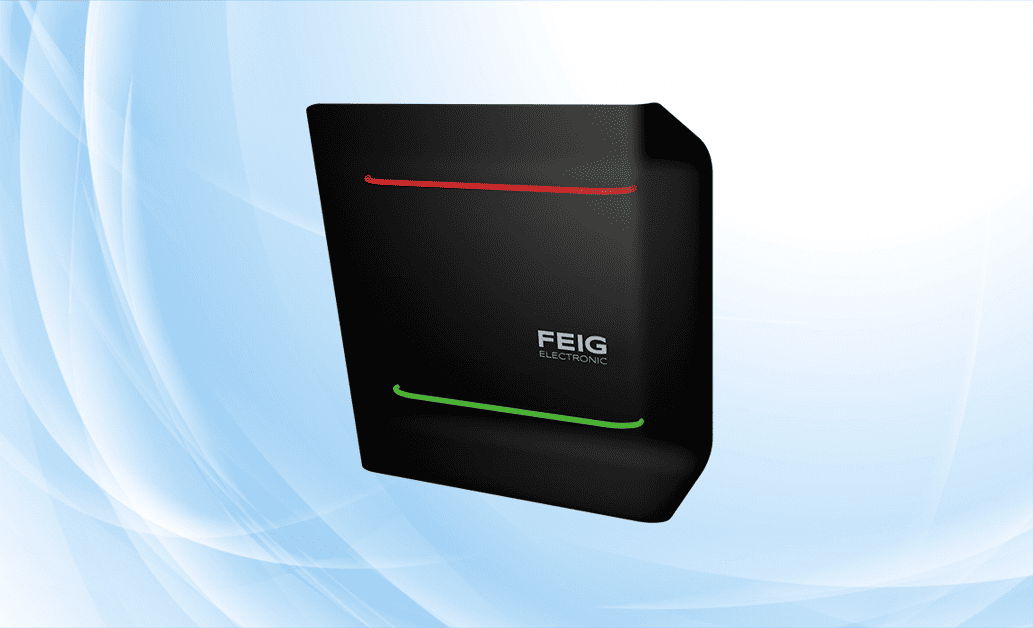
Positioning the vehicle using UHF RFID, also known as RAIN RFID, offers many advantages here. This technology works reliably and with track accuracy in tunnels and urban canyons and is also weather-independent. At the heart of the solution is FEIG’s LRU4000X or MRU400iX UHF RFID reader, which is mounted on or under the vehicle.

FEIG ID LRU4000X installed in the vehicle
Both readers are designed for use on rail vehicles and comply with all applicable testing standards in accordance with EN 50155. An RFID antenna for transponder detection is mounted under the vehicle. The MRU400iX has an integrated antenna and can therefore detect transponders without an additional external antenna when mounted correctly under the vehicle. Battery-free, robust, maintenance-free transponders are installed in the track bed for this purpose. These serve as waypoints and contain a unique identification number, which is read by the reader on the vehicle.
Thanks to their flexible communication interface, the FEIG LRU4000X and MRU400iX readers are able to communicate directly with the ITCS on-board computer – for example, via TRDP. Of course, both the Ethernet interface and the RS485 connection are designed as robust M12 round connectors, as is typical for railways.

robust, battery-free transponder in the track bed from smart-TEC
From transponder to action
When the vehicle or the RFID antenna under the vehicle passes a transponder mounted in the track bed, the reader transmits its unique ID to the on-board system. This then triggers the appropriate action, such as playing the announcement text in the vehicle at exactly the right moment.The RFID-based solution is reliable, mechanically robust, and low-maintenance. It is also relatively easy to install. If an additional waypoint is required during later operation, this can often be implemented by the operator themselves, primarily by installing an additional transponder.
In addition to passenger announcements, other processes, such as opening the vehicle doors at stops, can also be triggered or supported. The principle always remains the same: a transponder in the track bed is read by the RFID reader mounted on the vehicle and the information is forwarded to the on-board system. This can then decide which action to perform.
FEIG has been developing and supplying UHF RFID systems for railway applications for around 15 years. The robust RFID readers are specially designed for railway use and have proven themselves in many applications worldwide. Further application examples and information can be found here.